
Find Colorado Residents Through Records
A Colorado residents directory search works best when it begins with the question, not a long list of names. An owner search answers who holds a parcel; a voter record may confirm a registrant's filed address; a court docket shows a case role and event. For an older household, a printed directory, newspaper, or census record can add a date and family link. None of these sources lists every person at an address, and none is a single statewide resident roll.
Start with the county tied to the address or event. Then use a state portal for a state-held record, or a library and archive for older material. Keep the date, source, and record type with each result so a later match can be checked instead of assumed.
- Find the county, then check its assessor for the parcel owner and the Clerk & Recorder for deeds or liens.
- Use Go Vote Colorado only for its individual registration tools; public voter-file access has its own limits.
- Search the court docket, business files, or license lookup only when that record type fits the question.
- For a past resident, pair a directory year with deeds, census schedules, newspapers, or probate records.
- When a web index stops, ask the custodian about counter, book, archive, mail, or CORA request access.
Colorado's Resident Records Offices
Colorado divides these records among state agencies and 64 counties. Each county has its own assessor, Clerk & Recorder, elections custodian, treasurer, and court offices. A deed or property question begins with the county where the land sits; marriage records belong to the county that issued the license, and a divorce file stays with the district court that granted it.
State offices cover records that cross county lines. The Colorado State Archives holds state, county, and municipal collections; CDPHE handles vital records; the Secretary of State maintains election systems and business filings; and the Judicial Branch provides statewide docket search and access guidance. The Colorado street directory section explains how assessor, GIS, and deed records work together for an address.
Colorado State Archives
1313 Sherman St.
Denver, CO 80203
303-866-2358
Finding aids and record groups
CDPHE Vital Records
4300 Cherry Creek Drive South
Denver, CO 80246
303-692-2200
Order or correct a certificate
Colorado Secretary of State
Statewide election and voter tools
County clerks keep local voter files
Go Vote Colorado
Go Vote Colorado registration tools
Colorado County Records Start the Search
Colorado has no one deed index for all 64 counties. County assessors hold the current tax parcel record, while each Clerk & Recorder indexes deeds, deeds of trust, releases, plats, liens, and other instruments. The statewide public parcel service brings together fields supplied by counties: county, parcel ID, situs address, owner name, separate owner-mailing address, legal description, lot or block, ZIP, sale date, and assessed value.
The Colorado public parcel service is useful for mapping and routing, but its data can be incomplete or out of date. Confirm a result on the local assessor's own page. A mailing address can differ from the situs address; that shows where tax notices go, not who lives at the parcel. For a deed, follow the legal description and recorder entry rather than relying on a map popup alone.
- Parcel
- A tax account for a piece of land or property.
- Situs address
- The physical location recorded for the parcel.
- Mailing address
- The destination for the owner's tax notice.
- Legal description
- Lot, block, subdivision, or boundary terms used to identify land in a recorded instrument.
Colorado Voter Records Have Limits
Go Vote Colorado lets a person register, find or update their own record, view ballot status, and reach a county clerk. It is not a general block-by-block resident search. Under C.R.S. §1-2-227, public voter-file elements can include name, residential and mailing address, year of birth, party affiliation, vote history, and active or inactive status. Month and day of birth, signature, email, and identity numbers are confidential.
Full SCORE access is controlled, and the voter-file request form is limited to designated election officials. Protected voters and Address Confidentiality Program participants may have added safeguards. An active registration is a dated record, not proof that a person still lives at the listed address. For an individual, use the public Go Vote steps and treat the result as one point to confirm with the voter custodian.
Current Colorado Records by Source
A current Colorado residents directory question can lead to several different records, each with a distinct custodian and purpose. This table separates ownership, registration, case history, business affiliation, and past household evidence. None is a full roll of people who live in a home.
| Record source | What it identifies | Keeper | Access route |
|---|---|---|---|
| Assessor parcel | Tax owner, mailing and situs fields | County assessor | County portal, counter, or phone |
| Recorded instrument | Deed, lien, plat, and named parties | County Clerk & Recorder | Index, image, book search, or request |
| Voter record | Selected registration fields | County clerk / Secretary of State | Individual lookup or controlled request |
| Court docket | Case parties, court, date, and public events | Filing court | State search, clerk, or records request |
| Business or license file | Filer, agent, licensee, or status | Secretary of State / DORA | Public state lookup; details vary |
| Directories and papers | Past household, address, or community ties | Libraries and archives | Digital collections, microfilm, or reading room |
Ownership, voter registration, and a court role are different facts. A person named as an agent or signer may have no home link to the filing. When one person needs checking across several official records, the Colorado resident lookup page shows how to compare names, dates, counties, and source records.
Colorado Court Dockets Need a Date
The Colorado Judicial Branch docket search requires a date plus at least one other filter. Researchers can narrow by judicial district, county, courthouse, court type, case number, class, party, or attorney. A party search distinguishes an individual from a business, while a known year and sequence help sort cases with similar names.
The docket is a guide to cases and public events, not a place to get every document. Vendor registers may charge and do not supply official copies. Ask the filing court for a paper file, disposition, or certified copy. Denver County Court uses its own PublicPortal and data-request channel; municipal courts have local record keepers. Juvenile, sealed, expunged, and other protected cases may not appear.
The Judicial Branch public-records guide gives the request route. A name is only a starting point: compare court location, case number, party role, and outcome with the clerk.
Colorado Vital Records Require Eligibility
Birth, death, marriage, and divorce records are held through different offices. CDPHE Vital Records handles statewide birth and death certificates and selected marriage or divorce verifications. The Clerk & Recorder in the issuing county provides a marriage record, while the district court holds a divorce file. A state verification is not the same as the underlying decree or a certified certificate.
Colorado treats vital-statistics records as confidential under C.R.S. §25-2-117. A certified-copy applicant needs a direct and tangible interest, identification, and proof of eligibility. State birth records generally begin in 1910 and death records in 1900; older county records are uneven. The Archives limits birth research access to records at least 100 years old. For family history, check public indexes and historic newspaper or cemetery sources first, then use the eligible application route for a certificate.
Colorado Business Records Add Context
The Colorado Secretary of State business database can confirm an entity, trade name, filing date, status, registered agent, or named organizer. A filing reflects information submitted by the filer; it does not prove a person lives at the business address or that a company operates as claimed. SOS guidance suggests using an 11-digit ID when known, a partial name when it is not, and result pages for longer searches.
| Search field | Input type | Useful for |
|---|---|---|
| Entity or trade name | Text | Find a company or assumed name |
| ID or document number | Number or text | Open a known entity or filing |
| Date range and status | Advanced filters | Narrow filings by time or standing |
| Individual registrant | Name text | Find a filing tied to an organizer or agent |
Colorado SOS search tips explain name entry and result paging. DORA license verification is separate; its fields include profession, license type, name, number, and status. Both can add a date or affiliation to a resident search, but neither is a home-address file.
Colorado's Historical Resident Directories
The Denver Public Library lists name-arranged city directories from 1873-1923, with other formats extending further. Householder and criss-cross books start with an address and may name an owner, resident, or business. DPL's Colorado Directories Index helps locate volumes for towns outside Denver, since a small community may appear inside a neighboring area's phone or business book.
History Colorado's statewide guide adds town directories, telephone books, business directories, newspapers, census material, and Sanborn maps. DPL's Western History and Genealogy Department and the Stephen H. Hart Research Center are useful places to ask about physical volumes and licensed databases. A separate Colorado city directory guide lays out the collection and explains how to read an entry.
Colorado Recorder Dates Vary by County
Denver's online recorded-document database reaches back to 1859. Larimer County's Easy Access index starts in 1971, and older book searches are done at the Fort Collins office. The contrast matters for family and house history: a search that begins after the purchase date may miss the prior owner, while a neighboring county may have a different cutoff and a different image fee.
Larimer offers anonymous data-only access, free registration for watermarked images, paid copies, and a free Recording Activity Notification by name. Denver's index uploads scanned documents in daily batches, while paper material that is not yet digitized may be requested for retrieval. Check each Clerk & Recorder's own instructions before paying for an image or planning a trip. These dates are county examples, not a Colorado-wide online coverage promise.
Start at the official Larimer Easy Access page or Denver Clerk & Recorder information for those local routes.
Denver's Old Grid Changes the Search
A Denver house or street can appear under another number, name, or former place label in an older record. The city changed its street system in 1887, 1897, and 1904; the 1887 directory says that issue was delayed by the renumbering and name changes. Its street guide and Sanborn map sheets can help bridge the old and current labels. The parcel's legal description, lot, and block can then test whether both addresses refer to the same land.
Archives may file a record as Denver City, City and County of Denver, Denver County, former Arapahoe County, or a former place such as Montview, Colfax, or Barnum. Search more than one place name when a household seems to vanish. This documented history is a practical crosswalk, not an invitation to guess: tie the changed address to a legal description or mapped parcel before joining two records.
Colorado Custody Records Have Limits
The Colorado Department of Corrections search covers state custody, not every county jail or federal facility. The form accepts DOC number, last name, first name, and gender, then asks for CAPTCHA completion. Each sheriff manages its own jail roster and older booking records; Colorado has no statewide list of county-jail detainees. A missing state result therefore says little about a person outside DOC custody.
The state DOC locator is for its stated scope. For a county record, contact that sheriff's records unit and ask about a request under CORA or the Criminal Justice Records Act. The public CBI registry is another narrow database with statutory categories and a misuse warning. None of these systems is a broad Colorado residents directory.
Open the Colorado DOC Offender Search to see the state custody form's DOC number and name fields.
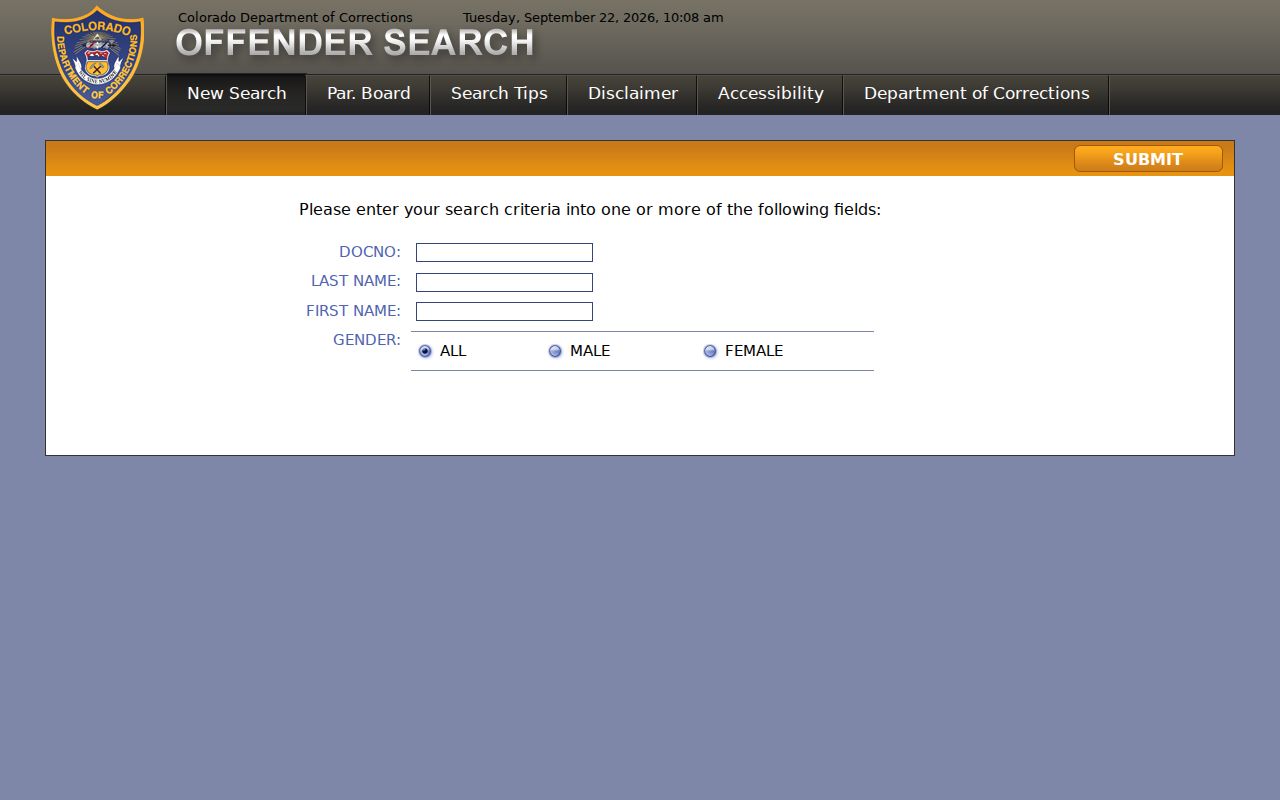
The search fields show which record the tool can return; a county jail file still requires a separate county contact.
Colorado Confidentiality Rules Protect Addresses
Colorado's Address Confidentiality Program gives qualifying relocated survivors and protected health-care workers a substitute address and mail forwarding. The program operates under C.R.S. §§24-30-2101 to 2114, and an actual address is not to be disclosed except as law permits. Voter files and court systems also have protected fields or case classes. Do not try to reconstruct a shielded address from nearby parcels, directory entries, or filings.
Public records can support family history, property research, and civic questions, but repeated contact, threats, or surveillance can become stalking or harassment. If a record appears wrong, contact the custodian and ask how to correct it. Do not repeat an unconfirmed match as fact.
Information about the Colorado Address Confidentiality Program describes its substitute-address and mail-forwarding service.
Official Rolls and Aggregated Records
Each Colorado government record is made for a defined purpose. The assessor keeps taxable parcels; the election custodian tracks registration; a court lists case events; and a business database preserves filings submitted by an entity. Commercial data brokers may combine public and marketing records, but their matches can be stale or merge two people with similar names. Use the custodian's record to verify a date or address.
| Source | Useful for | Limit |
|---|---|---|
| County or state office | Original record and a clear keeper | Several offices may split the trail; web years vary |
| Library or archive | Directories, maps, newspapers, and finding aids | Coverage depends on place, year, and access route |
| Commercial data broker | Clues combined across several source types | May be old, incomplete, or tied to the wrong person |
The Colorado Privacy Act grants covered consumers access, correction, deletion, portability, and certain opt-out rights for business-held data. Government-public information is generally outside the Act's personal-data definition. A request to a private business does not erase a lawful county deed or assessor record; correction requests for those records go to their custodian.
Colorado's 2025 Record Scam Warnings
Three 2025 alerts show how a public address or official name can be misused. In July, the Attorney General announced a lawsuit over business-record mailers that sought high fees for documents available through the Secretary of State. In August, the AG warned about fake jury-duty demands for money. A March alert described blackmail messages that reused names, phone numbers, addresses, or home images to make false threats.
Verify a fee or court notice through an agency number from its official site, not the phone or payment link in an unexpected message. Search Great Colorado Payback directly before paying a private claim service. Keep a threatening message and report it to the Attorney General's consumer-protection office or local law enforcement.
Read the official business-mailer alert, jury-duty warning, and blackmail notice.