
Colorado Previous Residents by Era
The backward trail varies by county and era. Denver is the fullest local example; all other Colorado counties need their own recorder cutoff. The table separates ownership transfers from household and building clues. A directory listing is not a deed, and a deed date may not equal a move date.
| Source | Years It Covers | Where Held | What It Shows |
|---|---|---|---|
| Denver recorded-document index | 1859-present | Denver Clerk & Recorder / CountyFusion | Recorded deeds, deeds of trust, liens, plats, and other instruments |
| Denver grantor volumes | 1859-1881 | DPL digital and research pages | Historic party names, volume references, and land trail |
| Larimer recorded-doc index | 1971-present online; older books searched at the office | Larimer County Clerk & Recorder | Recorded-document index; earlier book records require an office search |
| Denver assessor master cards | Late 1950s-early 1980s | DPL Special Collections | Parcel number and previous title names |
| Denver city and householder directories | Name-arranged: 1873-1923 at DPL; address-arranged runs 1924-2018 | DPL, Digital Collections, and library databases | Names and addresses; occupation and household clues |
| Denver building permits | 1889-1892 and 1900-1914 indexed or transcribed | DPL; newer path through Denver E-permits | Construction and alteration dates, address, applicant |
| Federal census schedules | 1860-1950 currently released | National Archives at Denver, DPL, and genealogy databases | Dated household snapshot and recorded relationships |
| Sanborn fire-insurance maps | Examples: 1887, 1893, 1903-1904; town years vary | Library of Congress, CU Boulder, and DPL | Building footprint, materials, and address changes |
| Newspapers and obituaries | 1860-present, depending on the paper | History Colorado, DPL, and Chronicling America | Death, move, family, and community clues |
Start with the county assessor and recorder, then use library indexes for earlier years. Denver's index reaches 1859, while Larimer's online index begins in 1971. Verify the other counties' cutoff because no statewide chart was found.
Colorado Parcel Records First
Before following past residents, pin down the parcel at the address. A Colorado street number may not identify the same property after block splits or street renaming. Save its parcel ID, situs address, owner mailing address, lot and block, subdivision, and legal description. Situs marks the parcel location; the mailing address is where tax notices go. They can differ.
County assessor data separates the situs and owner mailing address and can confirm the legal description to carry into the recorder search. It is not a deed and does not name everyone at the address. If the parcel or number is unclear, ask the county assessor for a map or counter search.
Colorado Deed Records Backward
Each county Clerk & Recorder holds its deeds. Denver's official CountyFusion recorded-document index reaches 1859-present; fields and images vary. Denver uploads scanned records in overnight batches, and paper not yet digitized may be requested for retrieval and digitization. The index is party-based, so an address search can miss a deed. Search owner and legal description, and distinguish a conveyance from a deed of trust, release, or lien.
For each transfer, log instrument and recording dates, parties, legal description, and book or reception number. Chain of title means the sequence of recorded transfers. A deed date may differ from a move date, and the chain does not list every person at an address.
The Denver portal's documented search clues are below. The live screen is dynamic, so field labels and image controls can vary.
| Field Label | Type | Required | Options / Format Notes |
|---|---|---|---|
| Party / Name | Text | No | Grantor, grantee, or indexed party; exact portal syntax varies. |
| Document type / category | Dropdown | No | May include deeds, releases, liens, easements, plats, judgments, and other county categories. |
| Reception / document number | Text | No | County-assigned reception or document identifier. |
| Recording date | Date range | No | From-to date fields can narrow a search. |
| Book / page or volume | Text | No | Historic book, page, or volume search where supported. |
| Legal description | Text | No | Lot, block, subdivision, or survey terms; county formats differ. |
| Search / submit | Button | N/A | Search and reset labels vary by interface. |
| Image | Link or control | N/A | Data, images, and certified-copy options differ by county. |
- Copy the current parcel number, owner name, situs address, lot and block, and legal description from the county assessor.
- Search the owner as grantee in the recorder index. Confirm the deed by matching the legal description and instrument type.
- Record the grantor, recording date, book or reception number, and any parcel or subdivision reference.
- Search that grantor as grantee to find an earlier transfer of the same parcel, then repeat toward older records.
- When an online index ends, use the county office's book search, counter, microfilm, or request route for earlier records.
- Grantor / grantee
- The grantor conveys an interest; the grantee receives it. In a purchase deed, these are often seller and buyer, respectively.
- Chain of title
- The linked sequence of recorded transfers for a parcel. Search each prior owner as a grantee to move back one link.
- Legal description
- The formal parcel description, often using lot, block, subdivision, or survey terms. It can keep a search on the same land when an address changes.
Colorado's Denver Grantor Records
Denver has a useful numerical contrast: the Clerk & Recorder's modern index reaches back to 1859, and DPL links grantor volumes for 1859-1881. Those older volumes can bridge a parcel's chain before the modern search interface. The records are organized around grantor and grantee names and book references, so carry the legal description and likely prior owner into the search rather than relying on the street address alone.
The Denver Public Library's Denver history resources connect grantor and grantee volumes with assessor cards, permits, and directory research.
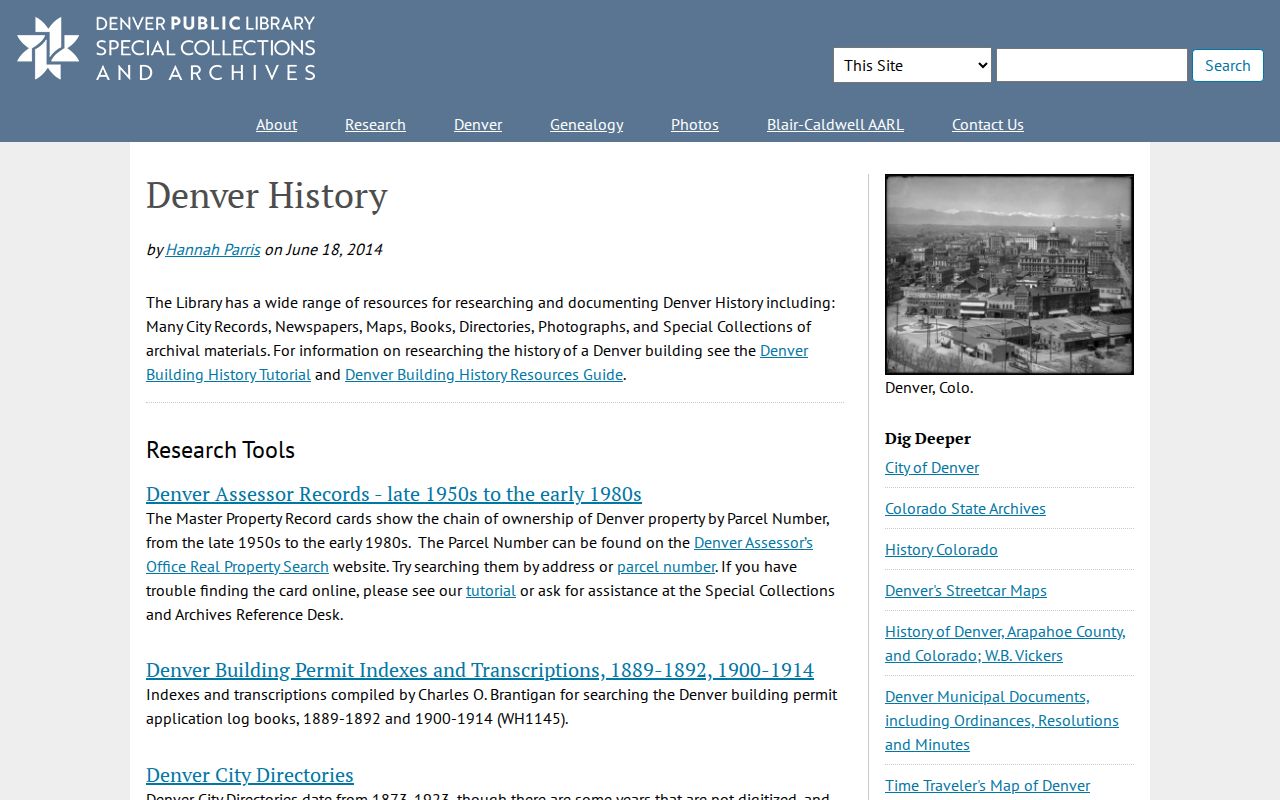
The library link is a guide to the historic name indexes, while the current transfer still needs confirmation with the county recorder.
DPL assessor master property cards cover the late 1950s through the early 1980s and may preserve parcel numbers and prior-owner clues for the years between deed books and newer web records. They belong to Special Collections, so ask the library how to request a specific card or parcel reference.
Colorado's Larimer Record Cutoff
Colorado's counties do not share one online start date. Larimer County's Easy Access recorded-documents search indexes records from 1971 forward; pre-1971 book searches are handled at the Clerk & Recorder's office at 200 W. Oak Street in Fort Collins. The office says it cannot search books for the public, so visitors need to conduct that search themselves. Anonymous users see data; free registration gives access to watermarked images, while unwatermarked copies can be bought online for $0.25 per page up to 8.5 by 14 inches, or $2 per page for larger images and plat pages.
Check the local recorder's cutoff for the county that holds the parcel. Larimer's 1971 boundary does not apply to Denver or a mountain-county address, and some counties rely more on book searches, microfilm, or counter help than on a web index.
Pair Colorado Directories and Census
Ownership is only one layer of an address history. A deed follows a recorded transfer, while directories and census schedules can add evidence about the people named at that place. In Denver, DPL's name-arranged books run from 1873-1923, and address-arranged householder volumes begin in 1924. The city-directory shelf itself is covered on the Colorado city directory page; here the task is to match one address through time. That distinction matters when tracing previous residents, because a directory listing does not prove a recorded ownership link.
- Set a rough ownership interval from the deed chain, but keep the recording date separate from a possible move date.
- Choose a directory year near the interval. Search by name in a name-arranged book, then use the householder volume when the address is known.
- Write down the exact street form, number, listed name, occupation, and any spouse or householder notation.
- Compare the closest released census schedule. Federal census day is April 1, and the currently released years end at 1950 under the 72-year rule.
- Check a nearby directory year or a newspaper notice when names or addresses do not line up. Do not treat a gap as proof that a person left or died.
Directories can bridge the long space between census decades, but their fields change by title and year. A listing may name one household head and omit other people at the same address. Keep a small chronology with the source, printed date, name, address, and what the record actually says. This makes a past-household clue easier to test against deeds, maps, and family records.
Colorado Address Records Changed
Denver is the clearest example of an address that can mislead a backward search. The city reset its numbering in 1887; street-name changes followed in the 1897 and 1904 ordinances. The 1887 directory says its publication was delayed by the work and includes a guide to streets and avenues. Search an old street name, an old number, and the modern legal description when a direct address search comes up empty.
Place labels can change too. State Archives warns that Denver records may be filed under City and County of Denver, Denver County, former Arapahoe County, or older settlement names such as Montview, Colfax, and Barnum. Compare the current location with the Denver street-name guide and the Colorado State Archives finding aids before ruling out a record. Denver's pattern is useful for its own addresses, not a statewide street grid.
Colorado Sanborn Map Records
A Sanborn fire-insurance map can show the building footprint, materials, nearby structures, and a number or street-name change. Colorado holdings are uneven by town and year. Denver examples include 1887, 1893, and 1903-1904; History Colorado lists Colorado maps from 1887-1962 on microfilm. DPL offers library-card access to map collections and prints, while other map libraries hold additional sets.
The History Colorado house-history guide outlines how to combine maps with assessor, recorder, newspaper, census, and library sources.

The guide gives a statewide research path for addresses outside Denver as well as a way to join maps and local records for a Denver parcel.
DPL's permit indexes and transcriptions cover Denver projects from 1889-1892 and 1900-1914; newer work can be searched through Denver E-permits and its process guide. A permit can date construction or an alteration and name an applicant, but that person may not be the owner or occupant. Use a permit as a building clue, then confirm names through deed and household sources.
Colorado Previous Residents and Obituaries
Newspapers, obituaries, probate files, and cemetery records can help explain a name that drops out of a directory. History Colorado reports more than 1,700 newspaper titles on microfilm and more than 650 online in the Colorado Historic Newspapers Collection. DPL adds its General Index, newspaper tools, yearbooks, oral histories, and genealogy collections. Coverage differs by paper, town, and year, so use an obituary or notice as one dated clue rather than a full address record. A sound account of past residents marks each source date and keeps household names distinct from recorded title changes.
Probate can connect an estate, heirs, and mailing addresses, but parts of a court file may be restricted. Marriage copies come from the county that issued the license; divorce files come from the district court where the decree was granted. For records that do not appear online, contact the holding county, library, cemetery, or archive and ask about its request process.
Lawful use. Previous-resident research belongs in family history, neighborhood history, and personal curiosity. Do not use names or addresses to track, threaten, or harass a living person.