
Find Colorado Residents Through Records
Every Colorado residents directory search should start with a question, not a name list. An owner search answers who holds a parcel. A voter record may confirm a registrant's filed address. A court docket shows a case role and an event tied to a person. Older households call for different tools. A printed directory, newspaper, or census record can add a date and a family link. No single source lists every person at an address. Colorado keeps no statewide resident roll. Start with the county tied to the address or the event. Then use a state portal for a state-held record, or turn to a library and archive for older material. Keep the date, source, and record type beside each result so a later match can be checked instead of assumed.
- Find the county, then check its assessor for the parcel owner and the Clerk & Recorder for deeds or liens.
- Use Go Vote Colorado only for its individual registration tools; public voter-file access has its own limits.
- Search the court docket, business files, or license lookup only when that record type fits the question.
- For a past resident, pair a directory year with deeds, census schedules, newspapers, or probate records.
- When a web index stops, ask the custodian about counter, book, archive, mail, or CORA request access.
Colorado's Resident Records Offices
Colorado spreads these records across state agencies and 64 counties. Each county runs its own assessor, Clerk & Recorder, elections custodian, treasurer, and court offices. A deed question begins where the land sits. Marriage records stay with the issuing county. A divorce file belongs to the district court that granted it. State offices handle what crosses county lines. The Colorado State Archives keeps state, county, and municipal collections. CDPHE handles vital records. The Secretary of State maintains election systems and business filings. The Judicial Branch offers statewide docket search and access guidance. The Colorado street directory section shows how assessor, GIS, and deed records work together. It covers all of them for one address.
Colorado State Archives
1313 Sherman St.
Denver, CO 80203
303-866-2358
Finding aids and record groups
CDPHE Vital Records
4300 Cherry Creek Drive South
Denver, CO 80246
303-692-2200
Order or correct a certificate
Colorado Secretary of State
Statewide election and voter tools
County clerks keep local voter files
Go Vote Colorado
Go Vote Colorado registration tools
Colorado County Records Start the Search
No single deed index covers all 64 Colorado counties. Each county handles its own recordings. Assessors hold the current tax parcel record, while each Clerk & Recorder indexes deeds, deeds of trust, releases, plats, liens, and other instruments. A statewide parcel service fills part of the gap. It gathers county-supplied fields: parcel ID, situs address, owner name, separate owner mailing address, legal description, lot or block, ZIP, sale date, and assessed value. The Colorado public parcel service is handy for mapping and routing. Its data can be out of date. Confirm a result on the local assessor's own page. A mailing address can differ from the situs address. It shows where tax notices go, not who lives at the parcel. For a deed, follow the legal description and recorder entry rather than a map popup alone.
- Parcel
- A tax account for a piece of land or property.
- Situs address
- The physical location recorded for the parcel.
- Mailing address
- The destination for the owner's tax notice.
- Legal description
- Lot, block, subdivision, or boundary terms used to identify land in a recorded instrument.
Colorado Voter Records Have Limits
Go Vote Colorado lets a person register, update their own record, view ballot status, and reach a county clerk. It is not a block-by-block resident search. The public voter file has limits. Under C.R.S. §1-2-227, public elements can include name, residential and mailing address, year of birth, party affiliation, vote history, and active or inactive status. Month and day of birth stay confidential. So do signatures, email addresses, and identity numbers. Full SCORE access is controlled, and the voter-file request form is limited to designated election officials. Protected voters and Address Confidentiality Program participants have added safeguards. An active registration is a dated record. It does not prove a person still lives at the listed address. Use the public Go Vote steps for yourself, and treat any result as one point to confirm with the voter custodian.
Current Colorado Records by Source
A current Colorado residents directory question can point to several records, each with its own custodian and purpose. This table separates ownership, registration, case history, business affiliation, and past household evidence. None is a full household roll. Owners are not always occupants.
| Record source | What it identifies | Keeper | Access route |
|---|---|---|---|
| Assessor parcel | Tax owner, mailing and situs fields | County assessor | County portal, counter, or phone |
| Recorded instrument | Deed, lien, plat, and named parties | County Clerk & Recorder | Index, image, book search, or request |
| Voter record | Selected registration fields | County clerk / Secretary of State | Individual lookup or controlled request |
| Court docket | Case parties, court, date, and public events | Filing court | State search, clerk, or records request |
| Business or license file | Filer, agent, licensee, or status | Secretary of State / DORA | Public state lookup; details vary |
| Directories and papers | Past household, address, or community ties | Libraries and archives | Digital collections, microfilm, or reading room |
Ownership and occupancy are not the same fact. Voter registration is a third thing. A person named as agent or signer on a filing may have no home link to it. When one person spans several official records, the Colorado resident lookup page shows how to compare names, dates, counties, and sources.
Colorado Court Dockets Need a Date
The Colorado Judicial Branch docket search needs a date plus at least one other filter. Narrow by judicial district, county, courthouse, court type, case number, class, party, or attorney. A party search separates a person from a business. A name is only a start. The docket lists cases and public events. It is not a place to get every document. A known year and case sequence help sort files with similar names. Vendor registers may charge. They do not supply official copies. Ask the filing court for a paper file, disposition, or certified copy. Denver County Court runs its own PublicPortal and a separate data-request channel. Municipal courts keep local record keepers. Juvenile, sealed, expunged, and other protected cases may not appear in any search. The Judicial Branch public-records guide gives the request route. Compare court location, case number, party role, and outcome with the clerk.
Colorado Vital Records Require Eligibility
Colorado keeps its vital records split across several offices. CDPHE Vital Records issues statewide birth and death certificates and handles some marriage and divorce verifications, while a marriage record sits with the Clerk & Recorder in the issuing county. Divorce files belong to the district court. Keep those pieces straight. A state verification is not the decree itself, nor a certified certificate.
Confidentiality comes from C.R.S. §25-2-117. An applicant needs a direct and tangible interest plus identification and proof of eligibility. Statewide birth records generally begin in 1910. Death records start in 1900. Older county coverage is uneven, and the Archives opens birth research only to records at least 100 years old. For family history, start with public indexes, historic newspapers, and cemetery sources, then use the eligible application route for an actual certificate.
Colorado Business Records Add Context
The Colorado Secretary of State runs a statewide business database. It can confirm an entity, trade name, filing date, status, registered agent, or named organizer. Remember what a filing is. It reflects information the filer submitted. That does not prove anyone lives at the business address. It does not prove the company operates as claimed. SOS tips suggest an 11-digit ID when you have one. Use a partial name when you do not. Try result paging for long searches.
| Search field | Input type | Useful for |
|---|---|---|
| Entity or trade name | Text | Find a company or assumed name |
| ID or document number | Number or text | Open a known entity or filing |
| Date range and status | Advanced filters | Narrow filings by time or standing |
| Individual registrant | Name text | Find a filing tied to an organizer or agent |
Colorado SOS search tips explain name entry and result paging. DORA license verification is a separate tool. Its fields cover profession, license type, name, number, and status, and it can add a date or affiliation to a resident lookup, though neither source is a home-address file.
Colorado's Historical Resident Directories
Denver Public Library lists name-arranged city directories from 1873 to 1923. Other formats reach further. Householder and criss-cross books work in reverse. Start with an address, and the entry may name an owner, resident, or business. Small towns hide in odd places. A small community may appear inside a neighboring area's phone or business book. DPL's Colorado Directories Index is the tool for towns beyond Denver. History Colorado's statewide guide widens the shelf. It adds town directories, telephone books, business directories, newspapers, census material, and Sanborn maps. DPL's Western History and Genealogy Department and the Stephen H. Hart Research Center field questions on physical volumes and licensed databases. A separate Colorado city directory guide explains the collection.
Colorado Recorder Dates Vary by County
Colorado's recorders differ sharply in how far their online indexes reach. Denver's database goes back to 1859. Larimer County's Easy Access index starts in 1971. Older books live at the Fort Collins office. The cutoff contrast matters for family and house history research. A search that begins after a purchase date can miss the prior owner, and a neighboring county may carry a different cutoff plus a different image fee.
Larimer layers its access options. Anonymous users get data-only results, registered users get free watermarked images, copies cost money, and a free Recording Activity Notification follows activity under a name. Denver posts scanned documents in daily batches. Undigitized paper waits for a retrieval request. Read each Clerk & Recorder's own instructions before paying for an image or planning a trip, since these dates are county examples rather than a Colorado-wide online coverage promise. Start with the official Larimer Easy Access page or Denver Clerk & Recorder information for those local routes.
Denver's Old Grid Changes the Search
An old Denver record may show a house under a different number, name, or place label entirely. The city rebuilt its street system three times. Changes landed in 1887, 1897, and 1904. The 1887 directory itself was delayed by all that renumbering and renaming. Its street guide and Sanborn map sheets bridge old labels to current ones. A parcel's legal description, lot, and block then tests whether two addresses sit on the same land.
Place names pose a second puzzle. Archives may file a record as Denver City, City and County of Denver, Denver County, former Arapahoe County, or a former place like Montview, Colfax, or Barnum. So search more than one label. Vanishing households often just changed filing names. Treat this history as a crosswalk, not a guess. Tie the changed address to a legal description or a mapped parcel before joining two records.
Colorado Custody Records Have Limits
Colorado's DOC search covers state custody only. County jails and federal facilities stay outside it. The form takes a DOC number, last name, first name, and gender, then asks for CAPTCHA completion. Every sheriff runs a separate jail roster. Older booking records also stay local. Colorado has no statewide county-jail list. A missing state result therefore says little about anyone outside DOC custody. For a county record, contact that sheriff's records unit and ask about a request under CORA or the Criminal Justice Records Act. The public CBI registry is another narrow database, with statutory categories and a misuse warning. None of these systems is a broad Colorado residents directory. Open the Colorado DOC Offender Search to see the form's DOC number and name fields.
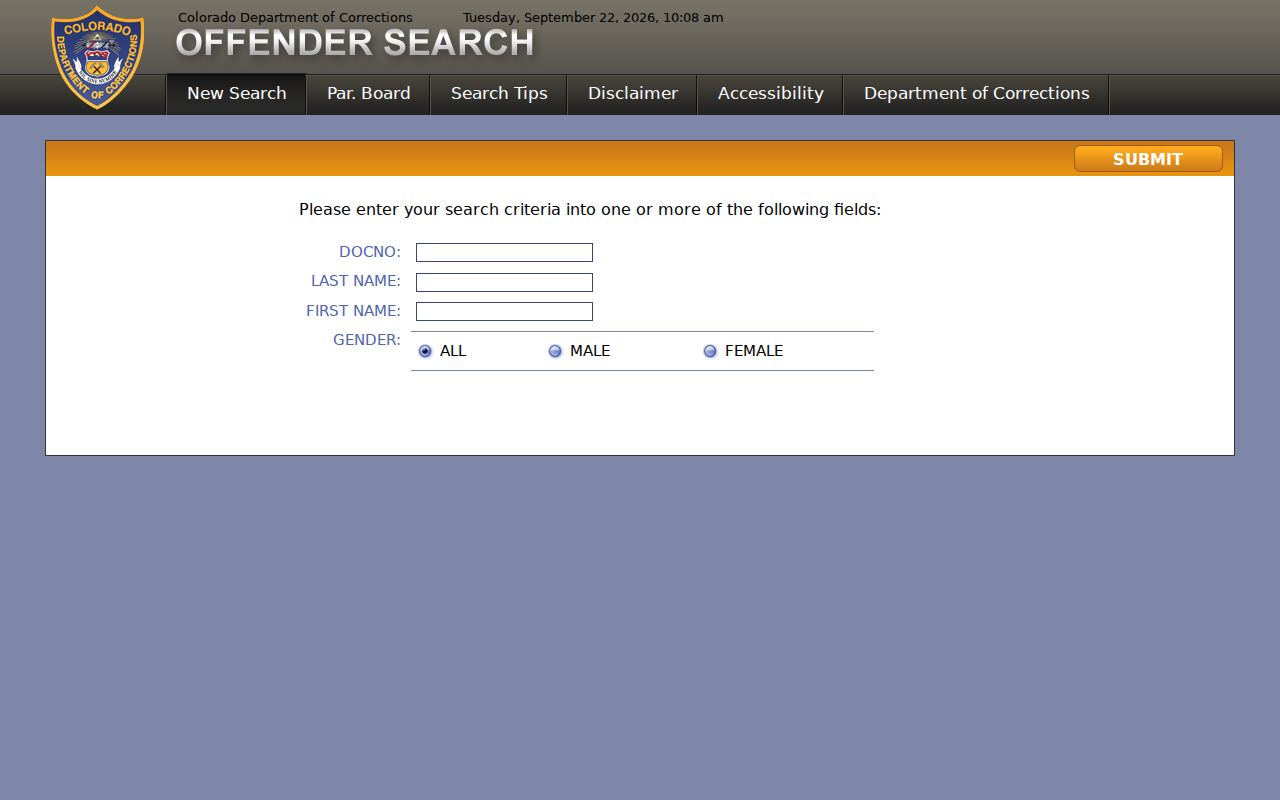
Those fields show exactly what the tool can return. A county jail file still takes a separate call to that county.
Colorado Confidentiality Rules Protect Addresses
Colorado runs an Address Confidentiality Program for relocated survivors and certain protected health-care workers. C.R.S. §§24-30-2101 to 2114 govern it. Members get a substitute address. The state forwards their mail. Disclosure of an actual address is barred except as the law allows. Voter files carry protected fields of their own. Court systems use separate case classes. Never try to rebuild a shielded address from neighboring parcels, residents directory listings, or filings.
Public records serve real purposes. They help with family history, property rolls, and civic questions. But repeated contact, threats, or surveillance can cross into stalking or harassment. Found a record that looks wrong? Contact the custodian and ask how to correct it. Never repeat an unconfirmed match as fact.
The Colorado Address Confidentiality Program explains its substitute-address and mail-forwarding service in detail.
Official Rolls and Aggregated Records
Every Colorado government record exists for one defined purpose. The assessor keeps taxable parcels. The election custodian tracks voter rolls. A court lists case events, and a business database preserves an entity's filings. Commercial data brokers blend public and marketing records into their own street directory products, but their matches can be stale or merge two people with similar names. For a verified date or address, trust the custodian's record, not an aggregated city directory copy.
| Source | Useful for | Limit |
|---|---|---|
| County or state office | Original record and a clear keeper | Several offices may split the trail; web years vary |
| Library or archive | Directories, maps, newspapers, and finding aids | Coverage depends on place, year, and access route |
| Commercial data broker | Clues combined across several source types | May be old, incomplete, or tied to the wrong person |
The Colorado Privacy Act gives covered consumers access, correction, deletion, and portability. It also grants certain opt-out rights over business-held data. Government-published information generally sits outside the Act's personal-data definition. A deletion request to a private company will not erase a lawful county deed. The same goes for an assessor record. Corrections for those go to the records office that holds them.
Colorado's 2025 Record Scam Warnings
Three 2025 alerts show how a public address or an official name can be abused. In July, the Attorney General sued over business-record mailers. The mailers charged high fees for documents available through the Secretary of State. The August warning covered fake jury-duty demands for money. A March alert described blackmail messages reusing names, phone numbers, addresses, or home images. The messages made false threats look real.
Verify any fee or court notice by calling an agency number from its official site. Ignore the phone number or payment link inside an unexpected message. Check Great Colorado Payback directly before paying any claim service. Keep the threatening message. Report it to the Attorney General's consumer-protection office or local law enforcement.
The official business-mailer alert, jury-duty warning, and blackmail notice carry the full details.