
Colorado City Directory Holdings
Colorado has no single directory run for every community. Denver is the most fully mapped example; statewide holdings are found by town and county. Confirm each book's title, format, and year with its library. A missing local volume may be part of a regional title. Name lists, address lists, phone books, and business directories answer different questions.
| Collection | Years | Where Held | Access |
|---|---|---|---|
| Denver name-arranged annual books, including Corbett & Ballenger and Ballenger & Richards | DPL: 1873-1923; other indexes list 1866 and 1871-1979; microfilm listed to 1981 | Denver Public Library Western History and Genealogy | Digitized years, microfilm, library databases, and Special Collections |
| Denver householder and Polk-style criss-cross books | 1924-1937 digitized; DPL lists runs through 2018 | DPL Special Collections and Digital Collections | Address-arranged volumes; check which years are online |
| Colorado city, telephone, and business titles | Varies by municipality and county; index updated quarterly | DPL Colorado Directories Index | Search town headings, including starred entries, then confirm the title |
| Colorado city directories and business directories | City directories from the 1860s-1990s; business directories 1875-1956 | History Colorado Stephen H. Hart Research Center | Catalog and research-center confirmation; year ranges do not promise every volume |
| Denver business directories | 1875-1943; 1950; 1956 | DPL Special Collections | Consult the index or library staff to locate the volume |
| Telephone books and Municipal Facts | Colorado phone holdings from 1880 onward at History Colorado; Denver guides include 1912-1947; Municipal Facts 1909-1931 | DPL, Library of Congress telephone collection, and History Colorado | Physical and digitized access depends on the title and year |
| Auraria and Ninth Street resident histories | Auraria 1956-1974; Ninth Street 1924-1973 | DPL, History Colorado, and University of Colorado Denver projects | StoryMap and project pages; use as focused neighborhood sources |
A gap does not prove that nobody lived at an address. A volume may be missing, regional, or filed under another heading. History Colorado lists broad statewide holdings, including telephone directories from 1880 onward and Denver householder volumes from 1926-1986, but its catalog should confirm each title. Use the Colorado Directories Index for another county, then ask DPL or History Colorado about a physical or digitized copy.
Colorado's Denver Directory Shelf
DPL's Western History and Genealogy Department at Central Library, 10 W. 14th Avenue Parkway, Denver, holds the strongest detailed Denver series. The collection page describes name-arranged city directories from 1873-1923, while its building-history guide also lists earlier years, microfilm, and later formats. Ancestry Library Edition adds indexed Denver volumes from 1866 and 1871-1979 at DPL. Many early volumes are available through DPL Digital Collections. Those ranges overlap, but they describe different access routes, not one complete online sequence. Check the title, year, and format before planning a visit or search.
The Denver Public Library's collection page describes its city directories, householder books, business titles, and telephone books.
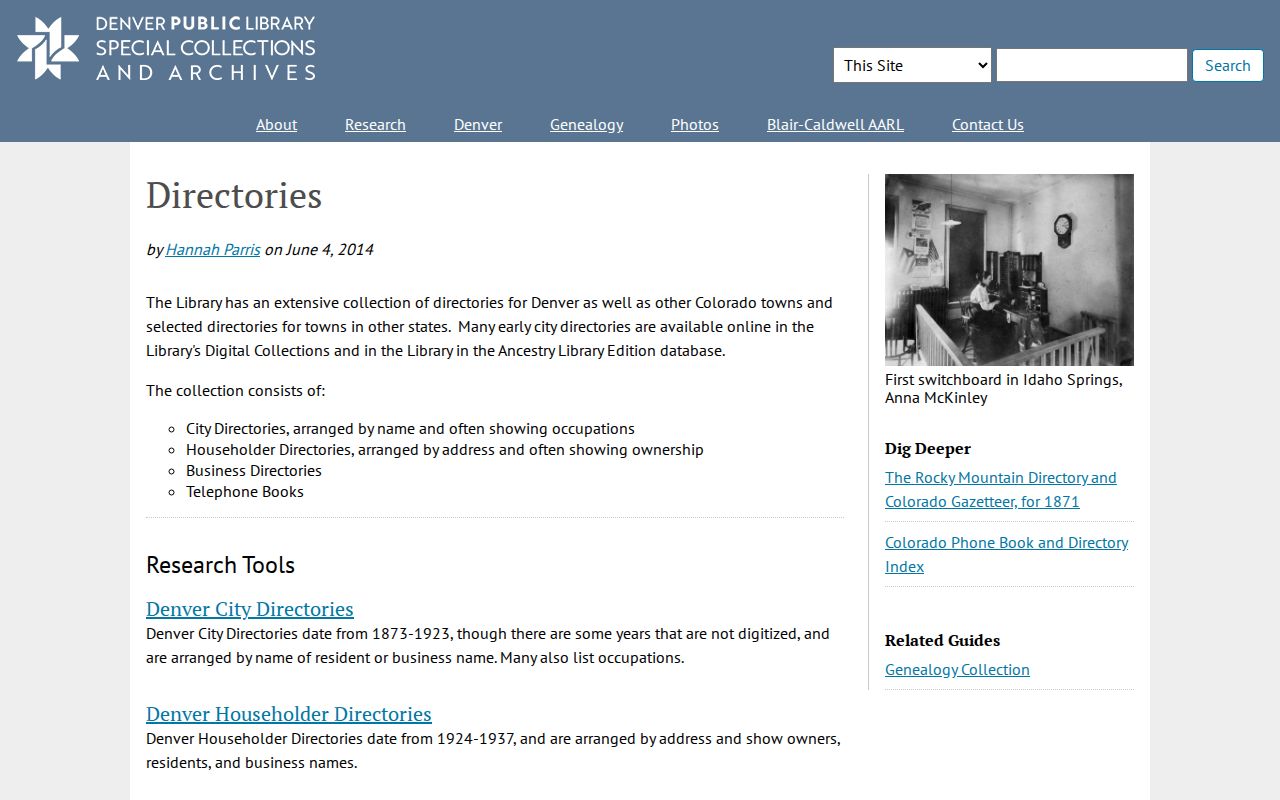
The collection page helps separate name-first books from address-first householder volumes before a search begins.
DPL keeps many older print and microfilm resources in Special Collections. Complex requests can be handled in the Western History and Genealogy reading room; materials need to be requested before the pull cutoff. Hours and current access details should be checked with the library before a trip, since the research source does not set one statewide schedule.
Colorado's Town Directory Index
A statewide search often begins with the town name, not a person's name. DPL's Colorado Directories Index is arranged by municipality and county. Its starred heading marks a town entry that may point to a book covering a wider area. A small place might appear inside the telephone book for a neighboring city, or in a regional business title, with no separate annual volume of its own.
Search the heading first, then note the title, year, format, and holding location shown in the index. Ask the library to confirm an uncertain citation before assuming a scan is online. For rural or mountain communities, History Colorado provides a second holdings route through its Hart Research Center catalog. A statewide year range means material exists somewhere in that range; it does not guarantee a book for every town or year.
Reading Colorado Directory Entries
Most name-arranged books list a household head with a street address and occupation. Some put a spouse in parentheses or italics; business sections may list a firm, partners, or officers. A separate street guide, ward list, public-official section, and abbreviation key may sit elsewhere in the same volume. Read the front matter and key before interpreting a mark. A listed name is a useful lead, but it does not by itself establish who held title to a parcel or every person who lived there.
| Name | Given name and surname, or initials; some entries place a spouse in parentheses or italics. |
|---|---|
| Occupation | A trade, profession, firm, or business role may help distinguish people with the same name. |
| Address | Street number and name, with an apartment or room detail where the edition prints one. |
| Householder mark | Some volumes use a mark such as “h”; check that edition's key before reading it. |
| Other notes | Later books may mark a widow or a person who moved; the wording and abbreviations vary. |
- Criss-cross directory
- An address-arranged book that lists a person, owner, or business under a street and number.
- Householder index
- A later address-first volume; its listed person may be an occupant or owner, so check other records for title.
- Abbreviation key
- The volume's list of shortened terms and symbols. Find it before reading entries because marks can change between editions.
When a name looks wrong, try initials, spelling variants, and the address. Typesetting and later optical character recognition can both blur names, while the city guide can help resolve a street form.
Colorado's 1887 Directory Delay
Denver's 1887 city directory explains why it appeared late: publication waited while the city changed street names and numbers. The volume's own street-and-avenue guide, ward boundaries, and street directory turn it into a crosswalk as well as a name book. City ordinances in 1897 and 1904 then changed names and numbering again. A person may seem to vanish when a search follows only the modern street form.
For a Denver address, compare the old number and name in the directory with the library's street-name and number changes guide. Sanborn maps from 1887 show old and new numbers, while 1903-04 sheets show old and current street names. Lot, block, and legal-description details can anchor the place when the street label has shifted. This is a local history issue, not a sign that the record set ends at the city line.
Colorado Householder Directories
DPL's address-first householder books begin in 1924, with 1924-1937 digitized and hardcover or softcover runs listed through 2018. Its building-history guide gives a separate range for Denver householder directories, 1926-1986. History Colorado also lists Denver householder titles from 1926-1986. These ranges reflect different catalog descriptions and access sets. Check the exact year and copy rather than treating one span as a full, continuous run.
The DPL building-history resources explain how directories, permits, Sanborn maps, and telephone books fit into an address search.
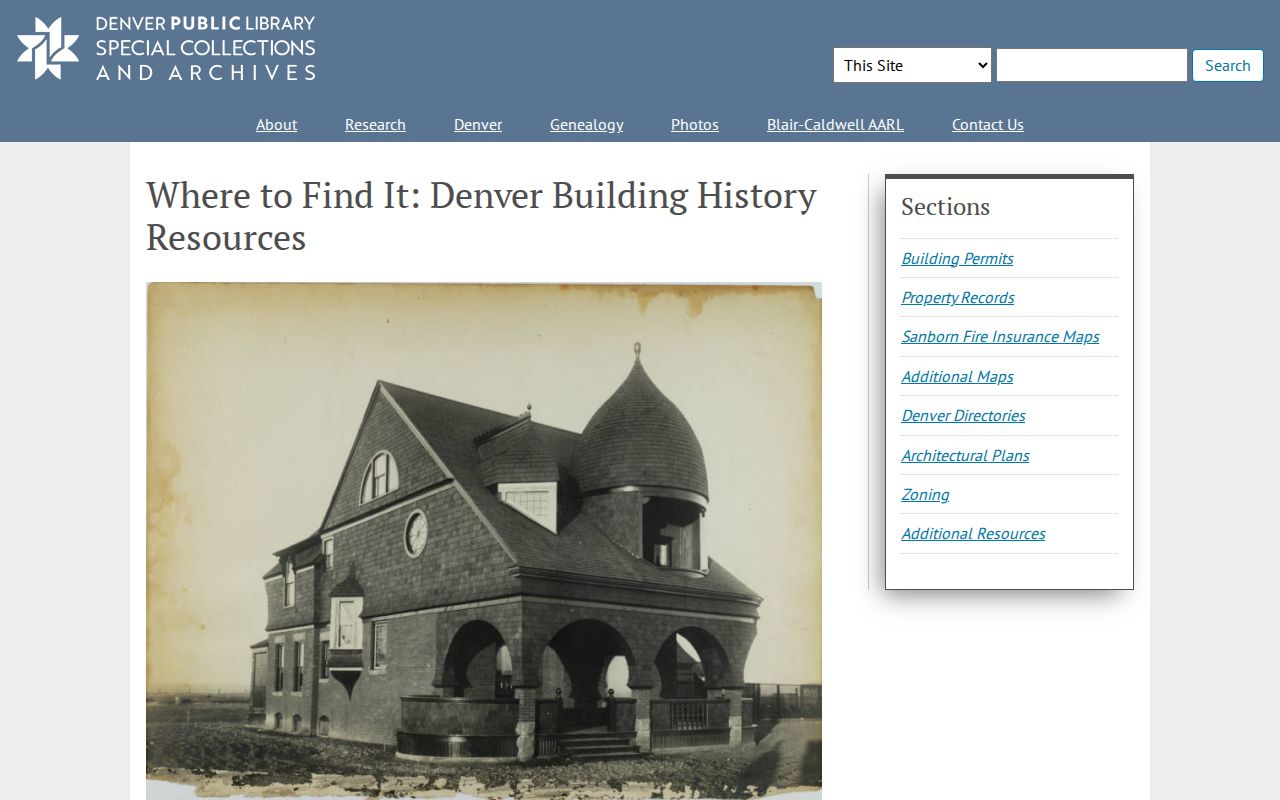
The guide pairs address-arranged books with map and permit sources, which helps separate a person listed at a place from the parcel's title record.
For a small Colorado town, the statewide index may point to a regional directory instead of a local householder volume. If no address-first book survives, use the name-arranged books and other local sources as separate evidence, rather than reading a missing entry as proof that an address was empty.
Trace Colorado Residents
Start with one person or one address, and keep the question narrow. A printed volume can show where a name appeared in a given year, but the meaning of that entry depends on the edition and its arrangement. Record the exact spelling, address, occupation, and any spouse or householder mark. Do not blend a name-arranged entry with a street-arranged listing as if they were the same record.
- Write down the person's full name, known year range, and any address already tied to the family.
- Use the Colorado Directories Index to identify a town, county, title, and year with a likely match.
- Search the name-arranged volume first, then note each address and occupation exactly as printed.
- Check an address-arranged householder volume when available, keeping its owner, resident, and business listings distinct.
- Compare nearby years and the closest census date; follow one address or surname at a time, and search initials or spelling variants if a line is missing.
A missing name can mean a move, a gap in the available books, a changed spelling, or a listing under a household head. It is not proof of death or departure by itself. Use a newspaper notice, obituary, census, or another dated source to test each possibility. For a statewide look, the history of Denver volumes is one rich example, not a substitute for the index of town and county holdings.
Pair Colorado Directories and Census
A census and a directory are snapshots made for different reasons. Federal census schedules count households on April 1 of the census year; the currently released federal schedules reach 1950 under the 72-year rule. City and householder books can add year-by-year or address-based context between those snapshots, but they do not supply the same fields or cover the same people.
Pick the closest directory year before or after a census date, then compare names, ages where present, address, and household relationships. A person could move between the two dates, and a directory might list only one person at an address. DPL's genealogy resources include census, newspapers, maps, yearbooks, and library databases; its 1950 census strategy recommends looking at nearby directory years when an exact year is missing or a name does not appear.
Keep each source's date in your notes. A householder line and a census household can strengthen a family-history lead when they agree, but a mismatch calls for another record, not a forced match.
Colorado Directory Maps and Family Sources
Directory entries gain context from Colorado newspapers, yearbooks, cemetery records, probate files, and historic maps. History Colorado's Hart Research Center lists newspaper holdings from more than 1,700 titles on microfilm, with more than 650 titles online in the Colorado Historic Newspapers Collection. DPL also provides newspaper and yearbook collections, census tools, oral histories, and genealogy databases. A local paper can help explain a move or death that a directory line cannot.
The History Colorado collections and archives page describes the statewide research center and its routes to collections.
History Colorado's collections are a statewide complement to DPL's Denver-focused directory shelf, especially when the person or town falls outside Denver. Its Auraria Residents StoryMap maps named residents and addresses from 1956-1974, while the Ninth Street Historic Park project lists 770 residents from 1924-1973, giving two focused neighborhood views. Confirm a specific title through the Hart Research Center catalog or by email before relying on a broad holdings range.
Archives can also preserve records under older place labels. Colorado State Archives cautions that Denver materials may be filed under City and County of Denver, Denver County, former Arapahoe County, or names such as Montview, Colfax, and Barnum. Search both a modern town name and the older jurisdiction before deciding that a record is absent. The State Archives finding aids help locate these record groups.
For an address-based research path beyond the historical shelf, the Colorado street directory page explains the current parcel and street-record sequence.